Hamburg Declaration: A Clean Energy Security Pact Reshaping the North Sea
A White Paper on UK-European Cooperation to Deliver an Integrated North Sea Clean Power System
Authors: Gareth Lewis (CoralPoint Partner & Regional Lead, EMEA), Dr. Lee Clarke (CoralPoint Partner & Senior Advisor)
On 26 January 2026, the UK and nine European nations formally signed the Hamburg Declaration—a landmark clean energy security pact at the North Sea Summit in Hamburg that commits the region to an unprecedented scale of offshore wind development and cross-border energy cooperation. This agreement represents a pivotal moment for European energy independence, industrial strategy and climate objectives, with implications that will ripple across supply chains, capital markets and labour demand for decades.
The Hamburg Declaration: Official Framework and Signatories
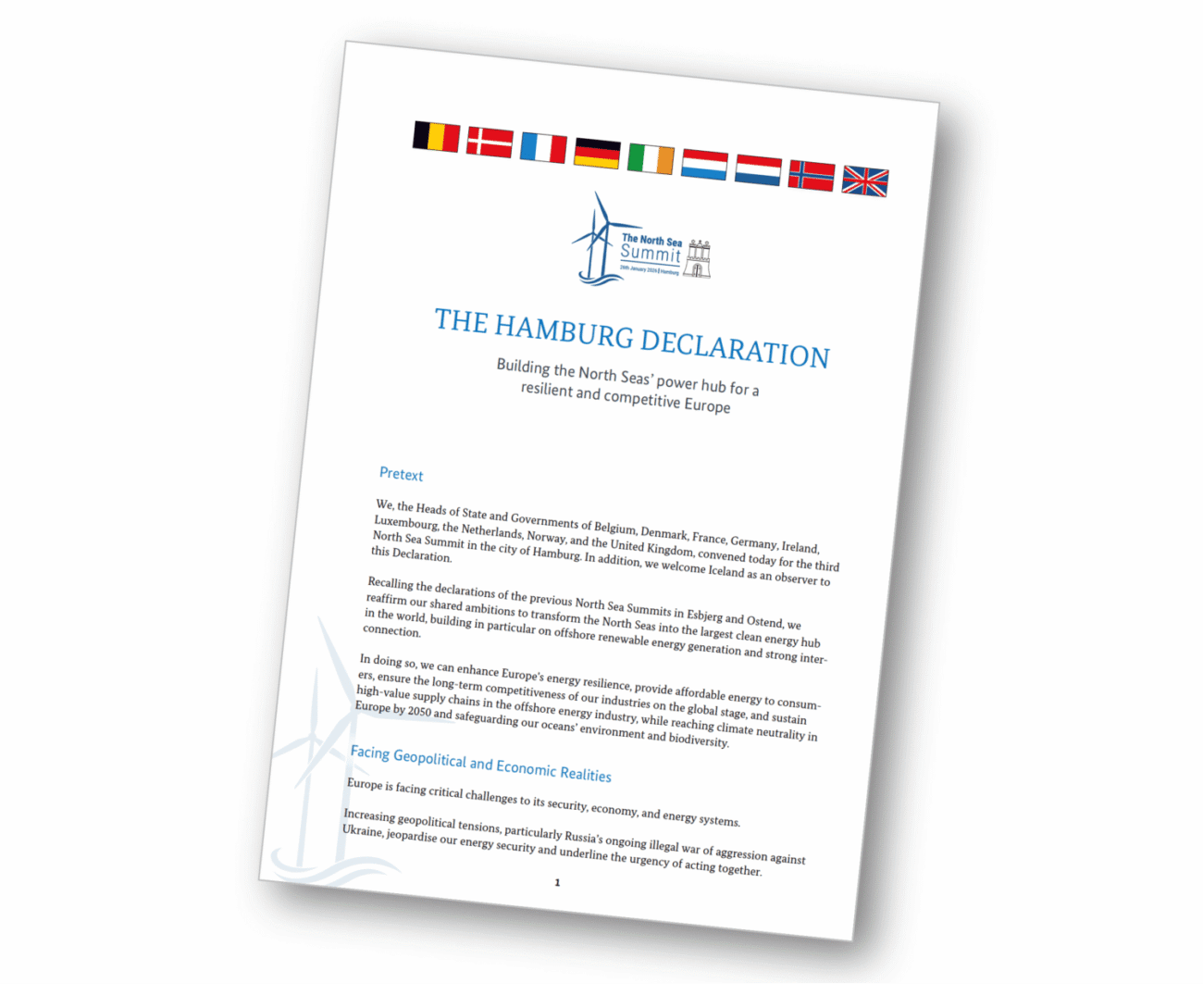
The Hamburg Declaration is the centrepiece of the North Sea Summit, signed by Energy Ministers from Belgium, Denmark, France, Germany, Iceland, Ireland, Luxembourg, the Netherlands, Norway and the United Kingdom. The declaration is underpinned by three formal instruments: a Heads of State Declaration (signed later on 26 January), an Energy Minister Declaration, and an Industry Declaration signed by more than 100 offshore wind companies representing the full value chain from developers to manufacturers and installers.
The pact emerges as a direct response to the 2022 energy security crisis caused by Russia’s invasion of Ukraine. It reflects a strategic reorientation toward energy sovereignty and abundant, clean offshore wind resources. This point was emphasised by the European Commission and Energy Ministers including the UK and Germany:
“In these turbulent geopolitical times, Europe must stand strong and united - and choose independence. That means doubling down on clean, safe, home-grown energy.” Dan Jørgensen, European Commissioner for Energy and Housing
“More than ever, the North Sea is a key strategic area for Europe. Together, we are strengthening our economic, security and energy policy interests in the North Sea. The vigorous expansion and smart networking of offshore energy creates affordable, clean and secure energy, reduces strategic dependencies and boosts overall European resilience.” Katherina Reiche, Germany’s Federal Minister for Economic Affairs and Climate Action
The agreement ensures that the "UK and EU allies double down on clean power as route to energy sovereignty and abundance, protecting the British people and strengthening national security.” Ed Miliband, UK Energy Secretary

The 100 GW Joint Offshore Wind Commitment
At the core of the Hamburg Declaration lies a binding commitment to deliver 100 GW of jointly developed offshore wind projects in the North Sea by 2050, as part of the wider ambition to reach around 300 GW of offshore wind capacity in the North Seas region by 2050 first pledged in 2021.
These joint projects differ from traditional offshore wind farms connected to a single nation. Instead, they comprise:
- Offshore hybrid assets: Advanced subsea energy infrastructure combining offshore wind generation with electricity interconnectors, directly linking two or more countries and optimising cross-border electricity flows.
- Cross-border cooperation projects: Wind farms in one country specifically designed for electricity transmission to another, reducing curtailment and improving grid stability.
- Integrated offshore grid infrastructure: Coordinated planning, cost-sharing mechanisms and market arrangements enabling efficient electricity routing across North Sea borders.
North Seas Energy Cooperation (NSEC) countries previously agreed to reach “at least 260 GW of offshore wind energy by 2050, complemented with intermediate targets of at least 76 GW by 2030 and 193 GW by 2040” representing “more than 85% of the EU‑wide ambition of reaching at least 300 GW by 2050.”
Government Commitments and De-risking Mechanisms
The Hamburg Declaration anchors several government-level commitments designed to address longstanding barriers to offshore wind investment:
- Investment certainty and auction design: Governments have committed to adopting two-sided Contracts for Difference (CfDs) as the standard auction mechanism across all participating nations. Two-sided CfDs provide revenue visibility by fixing both a floor and ceiling price, substantially reducing the cost of capital by mitigating revenue volatility – a critical factor for institutional investors and project finance.
- Regulatory harmonisation: All signatory governments pledge to remove regulatory obstacles to Power Purchase Agreements (PPAs); the direct bilateral electricity sale agreements between generators and corporate end-consumers. This harmonisation reduces transaction friction and unlocks additional investment pathways beyond government-subsidised mechanisms.
- Coordinated capacity build-out: Governments commit to a collectively managed annual deployment target of 15 GW of offshore wind during 2031-2040. This sustained pipeline represents a 40% increase from recent annual deployment rates and provides long-term visibility for supply chain investment in manufacturing capacity, port infrastructure and specialist vessels.
Industry Commitments and Economic Mobilisation
In return for government de-risking, Europe’s offshore wind industry has pledged to deliver measurable economic and cost benefits.
Exhibit 1: Offshore Wind Industry Pledges for the Hamburg Declaration
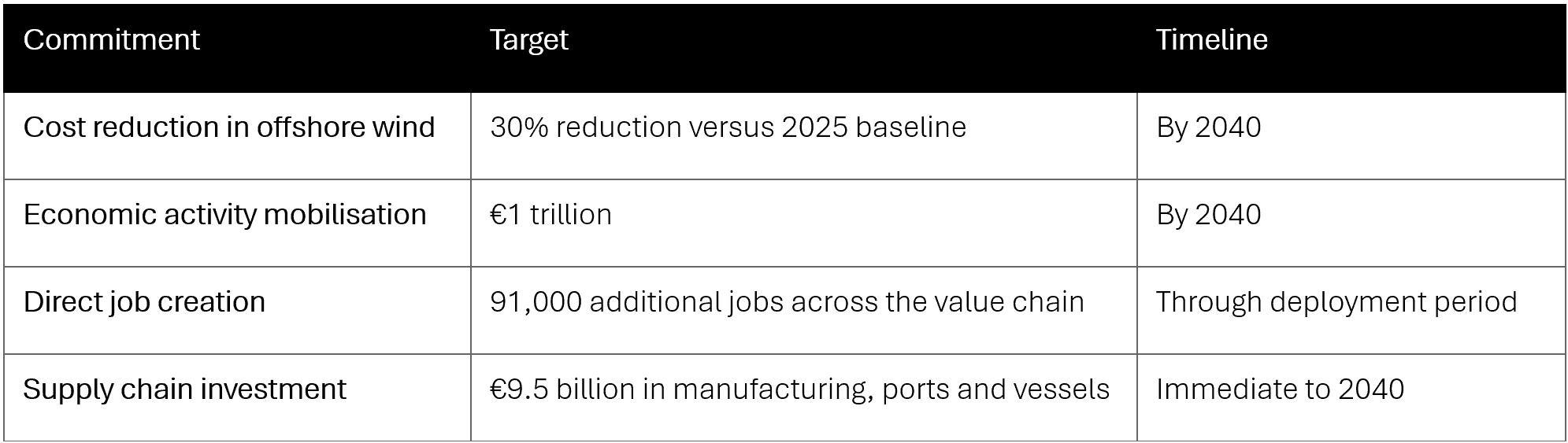
These cost reductions will be driven by three mechanisms:
- Scale effects from the predictable 15 GW annual deployment target.
- Lower weighted-average cost of capital (WACC) resulting from investment certainty and standardised financing frameworks.
- Further industrialisation of manufacturing, installation and servicing operations across European ports and fabrication yards.
Transmission System Operator Cooperation and Hybrid Projects
Transmission system operators (TSOs) from participating nations have committed to identifying cost-effective cross-border cooperation projects within the North Sea corridor. Specifically:
- TSOs will identify 20 GW of economically promising cross-border projects by 2027, with deployment primarily in the 2030s.
- These projects will include hybrid offshore assets (combining wind generation with interconnection) and single-country wind farms with designated cross-border transmission capacity.
- TSOs will develop transparent cost-sharing principles for these cooperation projects, addressing a longstanding barrier to transnational infrastructure development.
This represents a material shift in European offshore grid planning, moving from fragmented, nationally-optimised infrastructure to a coordinated North Sea offshore grid architecture.
Context: Record UK Auction and Leadership Position
The Hamburg Declaration arrives on the back of the UK’s record-breaking offshore wind auction, conducted in January 2026. This auction secured 8.4 GW of new capacity, the largest single auction in European history, across projects predominantly located in the North Sea. The auction is expected to unlock £22 billion (€25 billion) of private sector investment and create 7,000 direct jobs in UK ports, fabrication yards and supply chains.
By demonstrating both policy commitment and market delivery, the UK has positioned itself as a lead actor in the North Sea transformation, with Energy Secretary Miliband describing the Hamburg summit as an opportunity to “maximise the clean energy potential for the North Sea” in partnership with continental allies.
Subsidiary Agreements: Offshore Grid and Hybrid Asset Frameworks
Beyond the core Hamburg Declaration, the summit has produced two additional collaboration frameworks:
- Interconnected Offshore Grid Statement of Intent: Energy Secretary Miliband signed a statement of intent with Germany, Belgium, Denmark and the Netherlands to unlock cross-border offshore electricity projects. This non-binding but politically significant statement commits these five nations to joint planning, cost-sharing methodologies and harmonised market arrangements to accelerate hybrid asset and interconnector deployment.
- UK-Germany Offshore Hybrid Asset Framework: The UK has concluded a bilateral framework agreement with Germany to deepen collaboration on offshore hybrid assets and advanced subsea energy infrastructure. This agreement positions UK firms at the forefront of next-generation grid technology, opening export opportunities and supporting high-value manufacturing and engineering jobs.
Strategic Implications and Stakeholder Response
Industry, utilities and supply chain representatives have endorsed the Hamburg Declaration with measured confidence. Ben Wilson, President of National Grid Ventures, emphasised that “collaboration on projects like these are key to delivering on more secure, affordable energy for British and European consumers.” Dhara Vyas, CEO of Energy UK, underscored the criticality of “maintaining the momentum of UK-EU alignment on electricity market coupling and ETS linkage,” acknowledging that regulatory integration remains essential to realising economic benefits.
The declaration also signals a strategic integration between renewable energy infrastructure and broader energy security objectives. Enrique Cornejo of Offshore Energies UK noted that “100 GW from such joint projects would become a major part of our shared North Sea energy mix, which will include oil, gas and also hydrogen for decades to come” reflecting recognition that the North Sea energy transition is a prolonged process requiring diversified pathways.
Opportunities Across the Value Chain
The Hamburg Declaration catalyses demand across the full offshore wind ecosystem:
- Manufacturing and port infrastructure: The 15 GW annual deployment target creates sustained demand for turbine manufacturing capacity, blade production, jacket fabrication, and port facilities. Industry has committed €9.5 billion in supply chain investment, signalling confidence in expansion.
- Interconnection and grid technology: The 100 GW joint project commitment and 20 GW of identified cross-border projects by 2027 accelerates demand for subsea cable systems, hybrid offshore platforms, and grid control and optimisation software.
- Professional services and project management: Cross-border project development, permitting, financing and delivery require expanded capacity in environmental consultancy, legal services, project finance and portfolio management across multiple jurisdictions.
- Skills and employment: The industry’s pledge of 91,000 additional jobs reflects demand for offshore engineers, vessel crews, skilled trades, project managers, grid operators, and specialists in cyber-security for critical infrastructure protection.
What Comes Next?
The Hamburg Declaration is a political commitment with binding legal implications for signatory governments regarding auction design, regulatory harmonisation and annual capacity targets. The test of efficacy will be measured in the following markers:
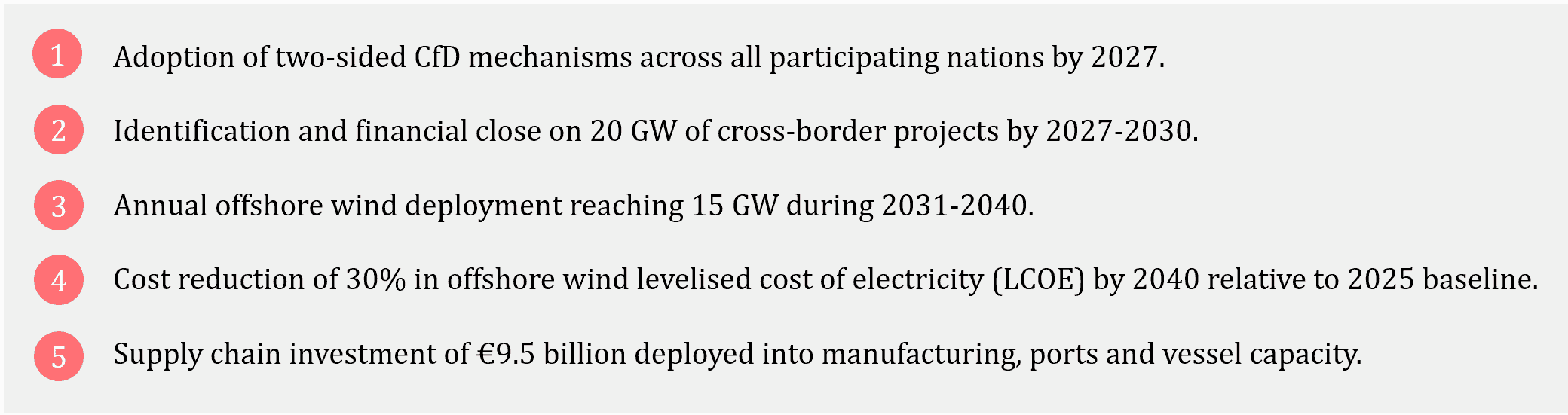
For executives and investors in the energy industry, infrastructure sector, and supply chains, the Hamburg Declaration represents a regime shift. It transforms offshore wind from a project-by-project policy experiment into a scaled, coordinated, multi-jurisdictional infrastructure programme with explicit government backing, cost-sharing mechanisms, and a 24-year deployment horizon. Early positioning in cross-border consortia, supply chain resilience planning, and regulatory engagement will determine which organisations capture value from Europe’s clean energy transition.
As governments and industry move from declarations to delivery, CoralPoint is uniquely positioned to help turn this new era of UK-European clean energy cooperation into bankable, executable projects. Drawing on our integrated strategy, technical, commercial and environmental capabilities, we support clients across the full asset lifecycle – from origination, feasibility and grid/interconnection strategy through consenting, project management, and M&A and investment due diligence – always with a focus on deliverability, bankability and long‑term resilience in an increasingly interconnected North Sea system.
Sources:
BMWK (Jan 2026). The Hamburg Declaration – Building the North Seas’ power hub for a resilient and competitive Europe. https://www.bundeswirtschaftsministerium.de/Redaktion/EN/Downloads/M-O/nordsee-gipfel-2026/the-hamburg-declaration.pdf?__blob=publicationFile&v=5
European Commission (Jan 2026). Commission welcomes renewed commitment to power clean, independent and secure offshore energy in the North Seas region. https://energy.ec.europa.eu/news/commission-welcomes-renewed-commitment-power-clean-independent-and-secure-offshore-energy-north-seas-2026-01-26_en
BMWK (Jan 2026). More cross-border expansion of offshore wind energy and strengthening of the offshore sector: Germany hosting the 2026 international North Sea Summit. https://www.bundeswirtschaftsministerium.de/Redaktion/EN/Pressemitteilungen/2026/01/20260126-more-cross-border-expansion-of-offshore-wind-energy-and-strengthening-of-the-offshore-sector.html
UK DESNZ (Jan 2026). Press release – UK and Europe sign historic pact to drive clean energy future. https://www.gov.uk/government/news/uk-and-europe-sign-historic-pact-to-drive-clean-energy-future