Flash Note: Preparing for the Net-Zero Industry Act in Offshore Wind?

The first offshore wind tenders reveal why developers need to consider NZIA compliance alongside cost, technology selection, and procurement strategy.
Analysis by Jakob Dall Asmussen, Deputy Research Practice Lead (Aarhus, Denmark)
Belgium’s revised PEZ 1 offshore wind tender marks an important milestone in the implementation of the EU Net-Zero Industry Act (NZIA). Together with France’s AO10 and the Netherlands’ IJmuiden Ver Gamma tenders, it is among the first major offshore wind auctions to incorporate the new resilience requirements into project procurement.
Although the three countries apply the same European framework through different tender designs, they all point in the same direction. Supply-chain resilience is becoming part of project competition alongside price and technical performance. The significance lies not in the legal differences between the tenders, but in what they signal for the industry. Europe has entered a new phase in which developers increasingly compete on supply-chain compliance as well as turbine price.
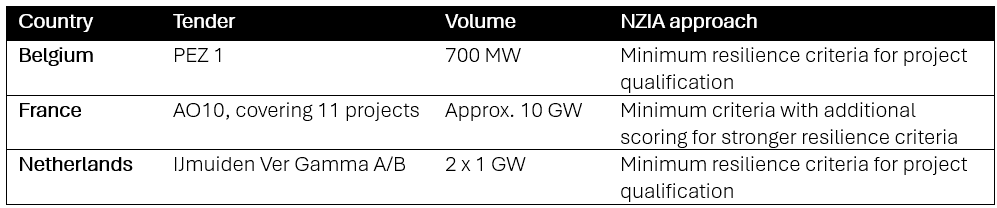
The three tenders implement the same resilience criteria through slightly different procurement models. Belgium and the Netherlands apply the criteria primarily as qualification requirements, while France also awards additional points to bids that exceed the minimum resilience criteria. Across all three tenders, developers must demonstrate that the assembled wind turbine and selected major components do not exceed the maximum share permitted to originate from a dominant third country. For most products, this threshold is 50%. Rather than requiring manufacturing to take place in Europe, the resilience criteria encourage greater diversification of the supply chain by limiting dependency on a single dominant source. Unlike traditional local-content requirements, compliance is determined by the manufacturing origin of turbines and key components rather than the nationality of the turbine manufacturer. A European OEM is therefore not automatically compliant if a turbine or major components originate in a dominant third country.
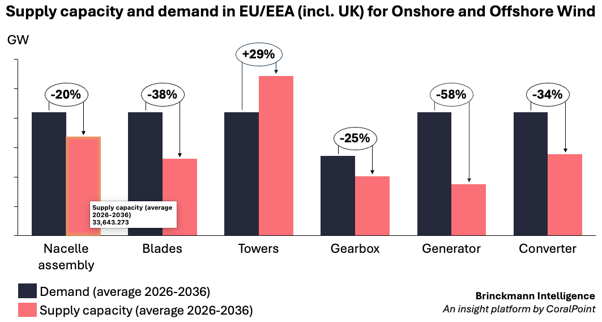
The implementation of NZIA raises an important question: Will resilience requirements create new supply bottlenecks for the European wind industry? While Europe has substantial manufacturing capacity overall, several key components already face tight regional supply. The resilience criteria are not limited to offshore wind. Ireland has already incorporated the NZIA requirements into its RESS 6 onshore auction, while France and Germany are preparing similar measures for future onshore wind tenders. As implementation expands, the availability of compliant manufacturing capacity will become increasingly important across both onshore and offshore wind markets.
The proposed Industrial Accelerator Act could complement NZIA by supporting the expansion of European manufacturing capacity, including through faster permitting and designated industrial acceleration areas.
Exhibit 1: Average manufacturing capacity versus demand for key wind turbine components in the EU/EEA (including the UK), 2026-2036. Source: Brinckmann Intelligence, an Insight Platform by CoralPoint
For permanent magnets, the global supply remains overwhelmingly concentrated in China. Both the Siemens Gamesa SG 14-15 DD and the Vestas V236 rely on permanent magnet generators. China accounts for around 90% of global NdFeB magnet manufacturing and more than 90% of the refining and alloying required to produce these magnets. Under the NZIA resilience criteria, up to 85% of permanent magnets may originate from a dominant third country. While this threshold appears relatively permissive, developers may increasingly compete for the remaining compliant supply. Even magnets manufactured outside China may still rely on Chinese rare-earth refining and alloying, making the assessment of manufacturing origin and supply-chain dependency more complex than it may initially appear.
What this means for developers
The commercial implication is clear: compliance may increasingly depend not only on selecting the right suppliers, but also on understanding the specific requirements of each tender and securing eligible manufacturing capacity early enough in the procurement process.
If you are developing a wind project and need to assess whether your sourcing strategy meets the NZIA resilience criteria, the specific requirements of an individual tender, local-content requirements or other market-specific obligations, or need to develop a practical compliance strategy, please contact:
Deepak Chinnapa
Partner, Strategy & Commercial
dch@brinckmanngroup.com
+49 152 3465 8017
Or,
Gareth Lewis
Senior Partner
gareth Lewis@coralpointgroup.com
+44 7748 104884
Sources:
- European Commission. Commission Implementing Regulation (EU) 2025/1176 specifying the pre-qualification and award criteria for renewable energy auctions. https://eur-lex.europa.eu/eli/reg_impl/2025/1176/oj/eng
- Belgian Federal Public Service Economy. Organisation of offshore tenders. https://economie.fgov.be/en/themes/energy/sources-and-carriers-energy/offshore/organisation-offshore-tenders
- Commission de régulation de l’énergie. AO10 tender specifications for eleven offshore wind projects. https://www.cre.fr/fileadmin/Documents/Appels_d_offres/2026/AO10_Cahier_des_charges.pdf
- Netherlands Enterprise Agency. Permit for IJmuiden Ver Wind Farm Site Gamma-A/B. https://english.rvo.nl/subsidies-financing/offshore-wind-energy/permit-ijmuiden-ver-gamma https://english.rvo.nl/subsidies-financing/offshore-wind-energy/permit-ijmuiden-ver-gamma-b