Flash Note: Denmark’s New Government Reaffirms Its Renewables Commitment
Flash briefing: How Denmark’s “greenest in history” cabinet provides renewed political backing for offshore wind, CfDs and green hydrogen.
Authors: Lars Hedemann (Partner, Aarhus), Lee Clarke (Partner, Basingstoke)
Denmark’s new government has provided a strong reaffirmation of the country’s commitment to renewable energy deployment, with offshore wind at the centre of its plans. Recent policy changes are intended to restore investor confidence and rebuild momentum after a period of pauses and cancelled tenders. The new cabinet reinforces the policy direction already established, while placing climate and energy firmly at the top of the political agenda and lending renewed top-down backing to the existing programme.
Following a closely contested vote and several weeks of negotiations, Prime Minister Mette Frederiksen now leads a centre‑left minority administration that has a desire to be the greenest in history (“Vi er drevet af en vilje til at være den grønneste regering”). The new government’s vision is that Denmark is self‑sufficient with green, cheap and secure energy. The governing agreement reaffirms Denmark’s 70% greenhouse gas reduction target by 2030 and positions offshore wind as a primary delivery vehicle.
The new cabinet reinforces continuity rather than a sharp change of course, while strengthening the political backing and delivery focus behind Denmark’s existing renewable‑energy trajectory. It inherits a sector bruised by policy reversals and explicitly links energy security, industrial competitiveness and climate ambition, giving renewed political cover for continued progress in the rollout of renewables. Samira Nawa Amini, as the new Minister for Climate, Energy and Utilities, will be a central political figure in turning Denmark’s offshore wind and wider renewables ambitions into concrete policy and delivery mechanisms.

Prime Minister Mette Frederiksen (left) and Minister of Climate, Energy and Utilities, Samira Nawa (right)
In recent years, Denmark’s offshore wind programme has faced headwinds, including suspension of the “open door” scheme and cancellation of a major 3 GW auction. These moves shook market confidence and raised questions over Denmark’s ability to meet its long‑term climate and energy goals. The policy response has been to redesign the framework for future projects around clearer rules, more predictable support and a transparent pipeline of opportunities for developers – a direction the new government now appears committed to maintaining.
At the heart of this framework is a move away from purely subsidy‑free tenders towards state‑backed contracts for difference. Around 3 GW of offshore wind is set to be tendered under a two‑sided CfD model, with initial auctions due from autumn 2025. This structure is intended to reflect current cost pressures in the supply chain while providing revenue stability, improving bankability and lowering financing risk at scale.
In parallel, Denmark continues to advance specific offshore areas, including Nordsøen Midt, Hesselø and Nordsøen Syd. Together, these zones will deliver at least 2.8 GW of new capacity, with ministers signalling that the 1 GW Nordsøen Syd tender will be brought forward to follow the ongoing 1.8 GW auction for Nordsøen Midt and Hesselø. This sequencing is designed to keep the project pipeline moving, leverage existing site knowledge and make more efficient use of grid planning and permitting work.
The coalition agreement sets out the intention to carry out an ambitious expansion of offshore wind in the North Sea and the Baltic Sea in close cooperation with neighbouring countries, contributing to Europe’s overall energy supply and security. It also pledges to maintain Danish and European strengths in this key technology and develop new secure supply chains.
However, the government’s ambitions extend beyond new wind capacity. Denmark is placing a strong emphasis on integrated energy infrastructure, including offshore grid connections, the Bornholm Energy Island and other potential energy-island concepts, alongside large-scale hydrogen and power-to-X development. These efforts support Denmark’s future role as a European player in hydrogen and green fuels, including through planned hydrogen infrastructure and an export route to Germany, and underline the country’s ambition to become a regional hub for green fuels and flexible clean energy.
Such measures are framed both as climate action and as industrial policy intended to draw in capital, create high‑value jobs and strengthen Denmark’s export position in the green economy. The new coalition agreement backs large‑scale offshore wind, electrification and power-to-X / green‑fuel infrastructure as core pillars of the energy strategy. It says the government will draw up a long-term roadmap: “Energy Infrastructure Plan 2035”.
For developers, suppliers and investors, Denmark is actively repositioning itself as a core European market for large‑scale offshore wind and related technologies. The combination of clearer auction volumes, a supportive CfD regime and a more predictable permitting interface is meant to provide the long‑term visibility needed to commit capital and supply‑chain capacity. The election outcome is an important signal of continuity and commitment, but the key test will still be how quickly projects move from tender to final investment decision and through to delivery – and whether political ambition is matched by timely execution on the ground.
Key takeaways
- Denmark’s election outcome provides renewed political backing for offshore wind and wider renewables, reaffirming a long-standing commitment rather than representing a fundamental change of direction.
- A new “greenest in history” cabinet gives strong top‑down support to climate and energy targets, including a 70% emissions reduction by 2030.
- The tender model is shifting to two‑sided CfDs for around 3 GW, improving revenue certainty and bankability for large projects.
- Nordsøen Midt, Hesselø and Nordsøen Syd form a fast‑tracked offshore pipeline of at least 2.8 GW, with Nordsøen Syd being brought forward.
- Integrated grid, hydrogen and Power‑to‑X plans aim to turn Denmark into a regional hub for green fuels and clean energy exports.
- For market participants, Denmark is signalling policy continuity, long-term ambition and continued relevance as one of Europe’s key offshore wind markets.
CoralPoint’s advisory team is ready to help you translate Denmark’s new policy landscape into bankable decisions for your energy transition portfolio and pipeline. From our Aarhus office in Denmark, and with global coverage and local presence across key markets, we support investors, developers and operators on strategy, transactions and project delivery across offshore wind, hydrogen, power‑to‑X, and other energy transition technologies. To discuss how we can support your plans, please contact the CoralPoint team in Aarhus or reach out via your usual CoralPoint relationship lead.
Sources:
- Danish Energy Agency (Nov 2025). The Danish Energy Agency opens tenders for three new Danish offshore wind farms. –https://ens.dk/en/press/danish-energy-agency-opens-tenders-three-new-danish-offshore-wind-farms
- Reuters (1 Jun 2026). Denmark’s Frederiksen secures third term as prime minister. – https://www.reuters.com/world/denmarks-frederiksen-secures-third-term-prime-minister-2026-06-01/
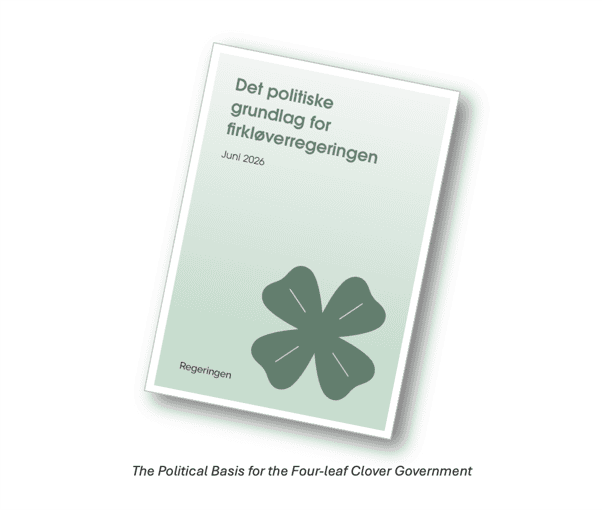
- Danish Prime Minister’s Office (2 Jun 2026). The political basis for the four-leaf clover government. – https://stm.dk/statsministeriet/publikationer/det-politiske-grundlag-for-firkloeverregeringen/
- Danish Prime Minister’s Office (3 Jun 2026). The Government of Mette Frederiksen III. – https://stm.dk/presse/pressemeddelelser/2026/regeringen-mette-frederiksen-iii/
- Danish Climate, Energy and Utilities (3 Jun 2026). Ministry for Samira Nawa is the new Minister of Climate, Energy and Utilities. – https://www.kefm.dk/aktuelt/nyheder/2026/jun/samira-nawa-er-ny-klima-energi-og-forsyningsminister
- Danish Council on Climate Change (Oct 2023). Denmark’s Climate Targets – English policy brief. – https://klimaraadet.dk/en/analysis/denmarks-climate-targets