Flash Note: From clean power to cheaper power – what the Budget reset means for UK offshore wind

The Budget of 28 October 2026 changed the question the government asks of new offshore wind. It is no longer how much clean power can be built by 2030, but whether each new project lowers bills and can connect to the grid.
Analysis by: Dr. Lee Clarke, Deepak Chinnapa
Within a week, ministers had applied that test to the current auction, AR8, and paused the next one, AR9, so the Contracts for Difference (CfD) scheme can be reformed. Fixed-bottom projects with firm grid connections look best placed. Floating wind and projects behind Scotland’s grid bottlenecks face the hardest test.
What changed
Six announcements in a week, read together, reset the terms for new offshore wind. Newest first:
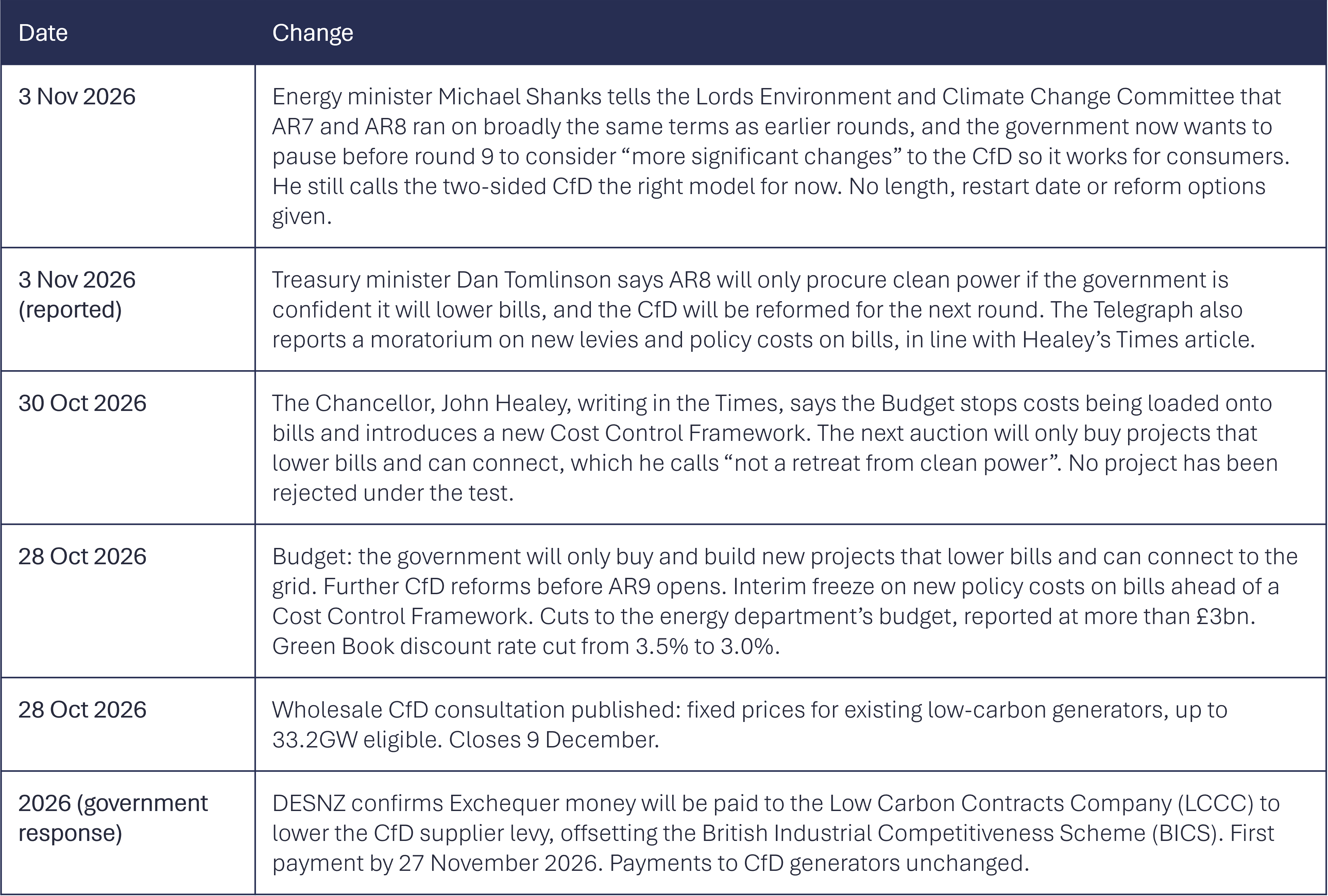
The common thread is cost. The government wants to stop adding to bills while keeping faith with existing CfD contracts.
AR8: same rules, a stricter buyer
AR8 goes ahead, but the government will judge it on bill impact as well as price. The auction rules are unchanged. Administrative strike prices are frozen at AR7 levels, and the initial pot budgets are due on 19 November, with results expected in mid-February 2027.
What has changed is how ministers will use their discretion. DESNZ can review bids above budget in four of the five pots and raise budgets where they offer value for money. In AR7 it used that power to double the offshore wind budget from £900m to £1.79bn. Our reading of the new test:
- Initial budgets matter more. Ministers now have an explicit reason not to stretch them, so 19 November is a better guide to the outcome than it was in AR7.
- Connection and location count alongside price. The government says the system costs of all new power, including constraint costs, should be considered. Projects with early delivery dates and uncertain connections, or behind known bottlenecks, are most exposed.
- The bill test is undefined. No method, metric or publication plan has been announced. Developers should ask how “lowers bills” will be judged before bids close.
- A freeze on new bill costs may bind AR8. Until a new Cost Control Framework arrives at the 2027 Spending Review, no new policy costs go on bills unless they cut bills or protect security of supply. It is unclear whether this constrains supplier-funded schemes such as AR8.
- One change helps long-lived assets. The lower Green Book discount rate gives more weight to savings in later years, which favours offshore wind in any value-for-money appraisal.
How would “lowers bills” be measured?
Ministers have not said. Three issues will decide who passes.
- Whole-system cost, not CfD payments. New wind lowers wholesale prices for all generation but adds curtailment, backup and system-service costs; a fair test nets both. On that basis, Aurora Energy Research puts offshore wind’s break-even strike price at up to £94/MWh, above AR7’s fixed-bottom prices and far below floating’s.
- No single break-even price. Value varies by technology, location and what else clears, so a project-by-project test risks replacing a simple auction with administrative judgement.
- Curtailment is outside developers’ control. It depends on other projects and on when grid upgrades arrive. Testing for it at auction adds policy risk and reopens the case for locational pricing, which the government ruled out.
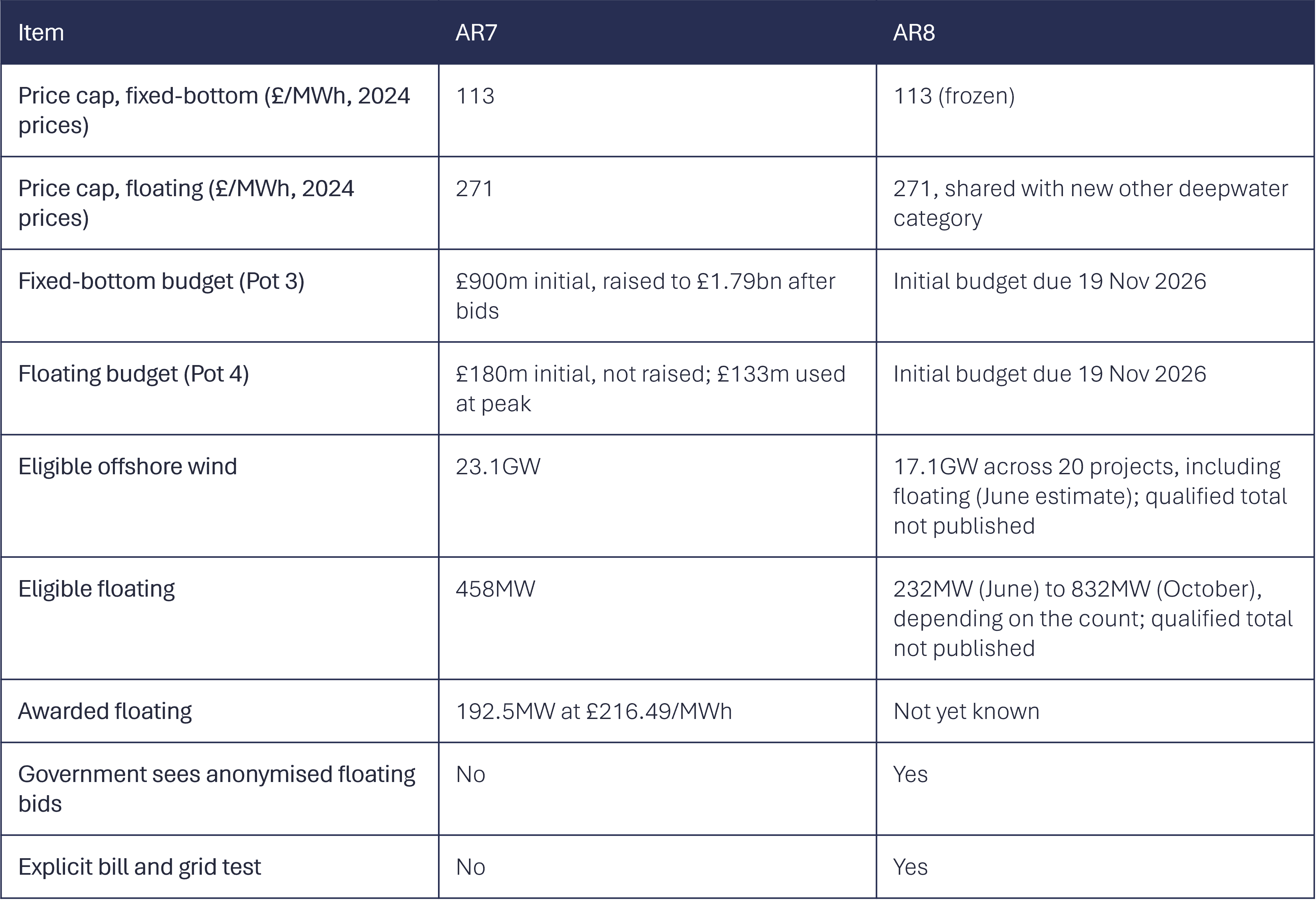
AR8 against AR7
AR8 keeps AR7’s price caps but adds a bill test, more bid visibility and a larger floating pipeline. The budget is the unknown.
Floating wind in AR8
Floating wind enters AR8 with a bigger pipeline, the same price cap and a buyer now asking whether each project lowers bills. Its fate rests on the Pot 4 budget set on 19 November and on whether ministers top it up after seeing bids.
- Floating costs about three times as much per MW as fixed-bottom. On NESO’s figures, AR7 floating used £133m a year for 192.5MW, about £0.69m per MW. Fixed-bottom used £1.78bn for 8,245MW, about £0.22m per MW.
- Funding the whole eligible pipeline could need up to three times AR7’s floating budget. At AR7 prices, the eligible floating pipeline would need about £160m a year at the June count (232MW) and about £575m at the October count (832MW), against AR7’s £180m. This is our arithmetic; the qualified total is not published and prices may fall.
- Bid visibility cuts both ways. For the first time the government sees anonymised floating bids before setting the final budget. In AR7 ministers saw only fixed-bottom bids; they doubled that budget and left floating at £180m. Under the bill test, the new visibility could as easily justify holding the floating budget down as raising it.
- Floating faces new competition in its own pot. Other deepwater designs now compete for Pot 4 at the same £271/MWh cap. One contractor’s analysis suggests some deepwater fixed designs could cost around a fifth less than floating at depths up to 120 metres.
- The case floating has to make is industrial. On cost per MWh it cannot pass a near-term bill test against fixed-bottom wind. Its argument is cost reduction, supply chain and access to deep waters. Shanks told peers there is no doubt the country wants some floating wind and the government will work on a way to support the industrial opportunity. But how much will be set in the strategic spatial energy plan (SSEP), and he put affordability first.
- Beyond AR8, floating policy is Scottish policy. RenewableUK reports nearly 14GW of floating capacity in the planning system, all of it in Scotland. An SSEP pathway weighted towards onshore wind and solar, or one limiting Scottish capacity, would fall mainly on floating wind.
AR9 and beyond: a pause for reform
AR9, due in 2027, is on hold, and the move to an annual auction cycle is interrupted. No restart date or reform consultation has been announced.
The direction is clear even if the detail is not. Tomlinson says the reformed CfD will aim to build the lowest-cost system, fix market distortions and site assets in the right place. The Telegraph reported that Shanks described a plan to stop too much future capacity being built in Scotland. The transcript does not show that. His Scotland remark came in a discussion of the SSEP: a logically designed system might not have put so many wind farms so far from demand.
Two Budget vehicles will carry the wider reform. The 10-Year Plan is expected to settle how generators make siting and investment decisions under Reformed National Pricing, with locational pricing already ruled out. The Cost Control Framework will set budgets for parts of energy costs, including policy costs.
The SSEP is where location will be decided. NESO has given DESNZ six pathways, from mostly onshore wind and solar to mostly offshore wind, all meeting security of supply standards and carbon budgets. The Secretary of State will pick one in the coming months, choosing first on cost, then on industrial advantage and land use. Shanks said the pathway should be published in the first quarter of 2027, consulted on, and finalised at the end of 2027.
On the grid, Shanks blamed constraint costs on the network, not developers, and said most of them come from switching on gas after wind is curtailed. His test for any technology was blunt: if it adds money to bills, “we might just not be able to support them”.
Our reading of what follows:
- Locational signals in the auction. Regional limits, bids weighted by grid connection, or assessment on bill impact rather than strike price alone are all possible. None has been proposed yet.
- A year’s delay for the pipeline. Projects that miss AR8 now wait at least until 2028 for a contract. That pushes back final investment decisions, supply chain bookings and seabed lease milestones.
- A rival use of headroom on bills. The wholesale CfD scheme expects a one-off auction from late 2027 and contracts in 2028. It would fix prices for existing generators, cutting exposure to gas prices without paying for new build. It competes with new offshore wind for political attention and bill headroom in the same window.
- Clean Industry Bonus timing. The bonus covers AR7, AR8 and AR9, and expires for rounds set up after 31 December 2028 unless Parliament extends it. A long pause would squeeze its use.
- More Treasury money behind the levy. The BICS arrangement shows the Treasury will pay into LCCC to keep the visible CfD levy down, while generator payments stay whole. That gives a working route for future taxpayer support, but also hides some of the scheme’s real cost from the headline levy.
Investors have noticed. The UK Sustainable Investment and Finance Association warned that billions of pounds of capital could be at risk without urgent clarity. The government’s answer so far is that existing contracts are untouched.
Who is most exposed
The new test cuts along two lines: cost per MWh and grid position. AR7 prices show the cost gap; the National Audit Office (NAO) shows the grid one.
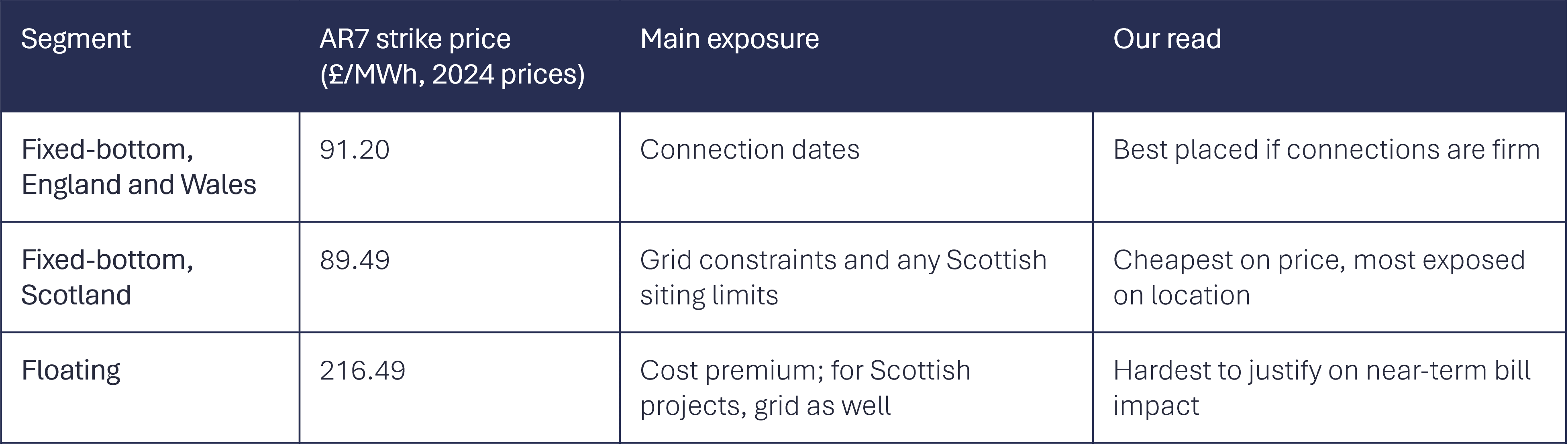
The grid cost is large and rising. Constraint costs reached £1.9bn in 2025-26 and could reach £6.6bn to £7.8bn in 2030 if grid upgrades are not accelerated. Scotland is reported to be behind the biggest bottlenecks, which is why location may now matter more than price for Scottish projects.
Floating wind’s case is industrial, not near-term cost. Aberdeen & Grampian Chamber of Commerce has asked for AR8 and later auctions to fund floating wind at scale. Industry voices are also floating a smaller, openly industrial floating programme funded outside the bill levy. The Budget offers a possible route: the National Wealth Fund gets an extra £15.4bn, including £2bn for a new Energy Wealth Fund to invest in renewable and low-carbon infrastructure. One caution: the Clean Industry Bonus is recovered through the CfD levy, so it does not take costs off bills.
What to watch
The AR8 budget notice on 19 November is the first hard evidence of how the new test will be applied.
- 18 Nov 2026: Ofgem deadline on AR8 eligibility appeals – Clears the way for the auction
- 19 Nov 2026: AR8 initial budget notice and sealed bid timing – First signal of appetite under the bill test
- By 27 Nov 2026: First Exchequer payment to LCCC for the BICS offset – Lowers the CfD levy from April 2027
- 3 to 9 Dec 2026 (indicative): AR8 sealed bid window – Bids lodged against the new test
- 9 Dec 2026: Wholesale CfD consultation closes – Shapes the rival scheme for existing generators
- Mid-Feb 2027 (indicative): AR8 results – Shows whether budgets were raised as in AR7
- Q1 2027 (expected): SSEP pathway published, with alternatives, for consultation – Sets how much offshore and floating wind the plan assumes, and where
- End 2027: SSEP final decision – Fixes the spatial basis for AR9 and later rounds
- Not set: AR9 reform consultation and restart date – Sets the terms for the next round
Sources
Government and Parliament
- DESNZ, Contracts for Difference for Low Carbon Electricity Generation: Government response to proposed legislative changes to support implementation of the British Industrial Competitiveness Scheme (2026)
- DESNZ, Wholesale Contracts for Difference consultation
- DESNZ, CfD AR8 pot and price notice, 6 July 2026
- DESNZ, Contracts for Difference Allocation Round 7 results
- DESNZ, Contract Budget Revision Notice for Allocation Round 7, 19 December 2025
- CfD Allocation Round 7: introduction online event Q&A
- House of Lords Environment and Climate Change Committee, oral evidence from Michael Shanks MP and Bill Jones, 3 November 2026; quotes checked against the parliamentlive.tv recording
- Hansard, Contracts for Difference (Sustainable Industry Rewards and Contract Budget Notice Amendments) Regulations 2026
- National Audit Office, Upgrading the electricity transmission network (summary)
Industry, analysis and press
- Aurora Energy Research, Achieving offshore wind goals with no burden on billpayers
- Offshore Source, Aberdeen Chamber warns billions in offshore wind investment at risk
- ORE Catapult, response to AR8 parameters
- The Telegraph, Burnham to halt wind and solar subsidies in net zero climbdown, 3 November 2026
- The Times, John Healey, “The chancellor says a resilient country deserves the chance to succeed”, 30 October 2026